
Revealing the Identity of a 19th Century Mystery Woman
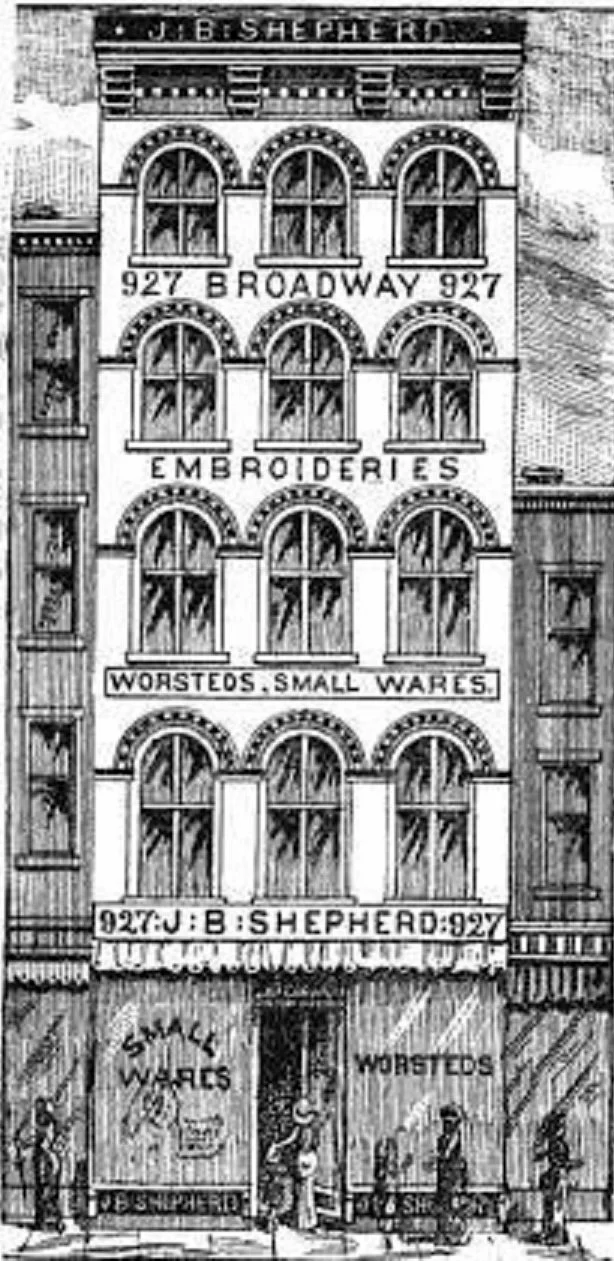
Several years ago I was asked to conduct a house history for 927 Broadway in New York City with two specific questions from the manager: Who was Sarah Mills (who supposedly had the house built), and were there any bizarre happenings that went on where spirits would be still walking the halls? Simple requests, one would think, but knowing genealogy and how difficult it is to track women in the early to mid-19th century, I was concerned that she would remain a mystery. Prior to 1850, records did not always include women. For instance, census records only listed the name of the head of household which was most often a male. Other family members only showed up as ticks in a column which listed gender and age ranges. Birth, marriage and death documents were scant during this time and because few women had rights or were not often in business, they were nearly invisible in records. For some time Sarah remained an enigma and probably would still be were it not for the fact that she owned property.
LOTS OF RECORDS, FEW ANSWERS
The Landmark Preservation Commission Historic Designation report for the Ladies’ Mile District includes 927 Broadway and lists Sarah Mills as the owner in 1857 when, supposedly, the building was constructed. Ladies’ Mile District consists of an area encompassing Broadway and Fifth Avenue, part of Sixth Avenue stretching from 15th Street up to 24th Street. It is an area which was lined with fashionable shops and stores during the nineteenth century. But my hunt to discover Sarah Mills’ identity led me to a different conclusion than the report indicated. I began my search by obtaining the property deeds and studied the purchase and sale by Sarah Mills. In these she is particularly noted as a “single woman,” in other words, she never married. My continued search led to maps, tax records, and even Minutes of the Common Council of the City of New York with her name attached to the property records. Yet not one provided any information beyond her name.
WHICH SARAH MILLS?
The next step would be to check genealogical records such as censuses, birth, marriage, and death, but problems abounded here as well. Aside from Sarah Mills being a rather common name, without being able to attach her to another individual, she could be any Sarah Mills in the records. The 1850 census was the first year to list all names in a household, not just the head of the household. Unfortunately, the only Sarah Mills which I discovered in those records were either too young to have owned property or were married.
BRICK WALLS ABOUND
Since we had no idea of Sarah’s age or where she was born, looking for a birth record would have been more difficult than looking for a needle in a haystack. Since the 1857 deed of sale to the next owner noted that she was still “single,” it was clear that she had remained so throughout her life. There was no point in looking for a marriage record. During that era, if she had been married, it would have noted her husband’s name or indicated that she was a widow rather than single if a husband had predeceased her. Given the brick walls presented by the other records, the next best bet would have been a death record. The only problem with that was that officially recording deaths was not mandated until the mid-nineteenth century, and because it took years before people began strictly following that mandate, it was questionable whether we would find one.
It appeared that we had run the gamut of typical records which might reveal Sarah Mills’ identity. So, where to go from here? There was only one place left to turn. Had Sarah not been a holder of real property she may have been a mystery still. The final place to turn was toward probate records. The real property of her estate was being sold off in 1857 by her executor, but this didn’t necessarily mean that she had died that year, nor, as I later found out, did it mean that she had died in the last ten years. Oddly enough, tax records continued to be recorded in her name up until 1859, further confusing the attempt to pinpoint a death date.
MYSTERY SOLVED
As it turns out, she died in August of 1849. This was discovered in probate records. Here I say, kudos to those who are working on digitizing and indexing old documents. Had these records not been searchable, it more than likely would have taken a considerably longer time to solve the mystery of Sarah Mills. But once I found a will which belonged to a Sarah Mills, how did I know this was the correct Sarah Mills? Thankfully, she detailed so many individuals in her life, including her brother-in-law, William Banta, who was also named as the executor in the sale of 927 Broadway in the 1857 deed and in a newspaper notice. This discovery opened the doors to her identity and her entire family.
ANOTHER MYSTERY
While the identity of Sarah Mills was discovered, to my client’s disappointment, no particularly bizarre events had occurred in the building as he had hoped. One mystery did remain though. If Sarah Mills died in 1849, how could she have built the house at 927 Broadway? The Landmark Preservation Commission’s Ladies’ Mile Historic District Report states that Sarah Mills was the builder/owner in 1857. How could that be? It appears that during Sarah Mills life, she had a 3-story building constructed on the lot, and the subsequent owner, William Knight, added 2 more stories at some point after his purchase in 1857. The full story of Sarah Mills and the house at 927 Broadway is documented in the book, Sarah Mills’ House. (See the details under the tab “Works.”)
